
Public Whale Watch
From $79 per guest · Up to 20 guests
The complete guide · December – April
Maui whale watching is a two-hour trip into the most important humpback nursery in the North Pacific, which begins a few hundred yards off the West Maui sand. The whales are here December – April, the peak is January, February and March, and this page covers the rest: where they are, what they do, which boat to pick and how to get ready. We run one of those boats, off Kaʻanapali Beach, and have written this the way we would say it on the deck.
Check Dates & BookMaui whale watching is unusual among wildlife trips in two ways. The animal is bigger than the boat you are sitting in, and you do not have to go far to find it. Every winter more than 10,000 humpbacks cross roughly 3,000 miles of open ocean from Alaska to the shallow, sheltered water between Maui, Lānaʻi and Molokaʻi, and they spend the season doing the things that happen at the surface: courting, competing, calving and singing. On a good morning in February you can see a blow from the beach before you have finished your coffee.
A boat trip here is short by the standards of whale watching elsewhere. Ours is 2 hours, and the run from the sand at Kaʻanapali to the first whale is usually minutes, because the channel the whales use starts just offshore. In season, sightings are not the question. What differs between one trip and another is how close to the water you sit, how many people share the rail, whether you can hear the whales as well as see them, and whether anyone aboard can tell you what you are looking at.
Each section below is a summary, with a link to the guide that goes into it properly.
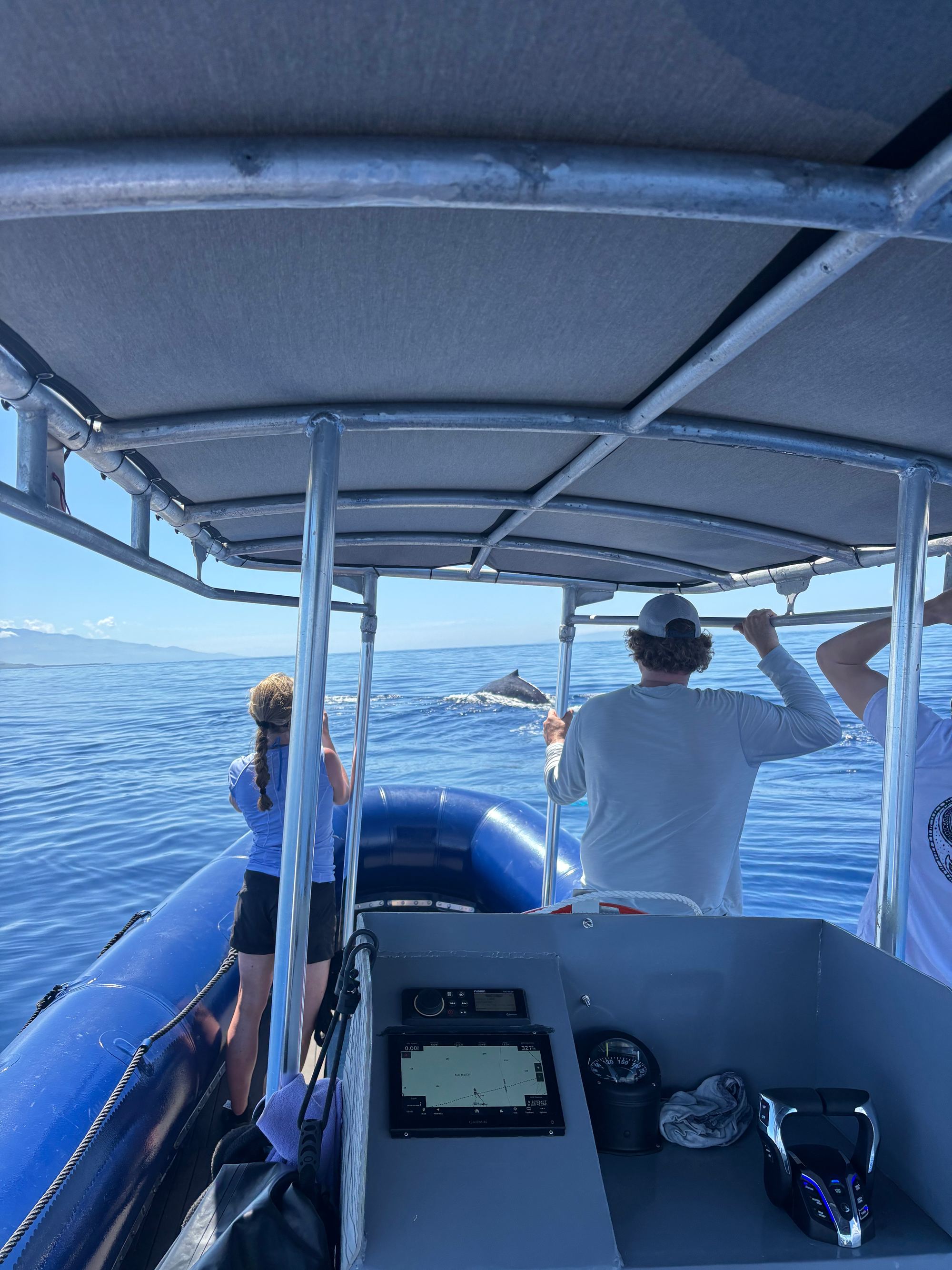
A whale surfacing beside the raft off Kaʻanapali
Whale season on Maui runs December – April; our trips for the coming season run from December 1, 2026 to April 30, 2027. The first scouts actually show up off West Maui in November and the last mothers and calves linger into May, but neither end is dependable enough to plan a holiday around.
Inside it, the season is not flat. Numbers climb week over week through December, pregnant females and mothers with yearlings first, males and juveniles behind them. By January competition pods are forming and surface displays become routine. February and March are the peak: the highest density of the year, calves being born, and singers everywhere on the hydrophone. In April the order reverses. Males and juveniles head north first; mothers with new calves stay latest, letting the calves put on weight for the crossing.
If you have a choice of dates, aim for the middle. If you do not, any trip inside the season is a whale trip; the difference is how many animals are in the channel and how much is happening at the surface. Peak weeks in January, February and March book out first, and within those months the morning departures go before the rest of the day.
Time of day matters almost as much. The trade winds usually build through the late morning and afternoon, so the channel is flattest early, and flat water is the difference between spotting a blow at a mile and losing it in the chop. Our first trip leaves at 7:00 AM. Late afternoon has its own case, which is the light; that is what the sunset charter is for.
December · BuildingSeason opens. Numbers climb week over week; pregnant females and mothers with yearlings arrive first.
January · HighCompetition pods form. Breaching, pec slaps and surface displays become routine.
February · PeakHighest density of the year. Calves are being born; singers are everywhere on the hydrophone.
March · PeakPeak continues. Mother-and-calf pairs close to shore in calm morning water.
April · DepartingMales and juveniles head north first. Mothers with new calves linger latest.
Most of the whale watching Maui is known for happens in one stretch of water. The Auʻau Channel lies between Maui, Lānaʻi and Molokaʻi, off the island's west side. It is shallow, rarely deeper than about 300 feet, and wrapped on three sides by high islands that block the trade winds, so it is warm, flat and short of large predators. For a newborn calf with almost no blubber and no swimming stamina, those three things are the difference between surviving the winter and not. That is why the humpbacks swim 3,000 miles to get here, and why this channel holds the highest density of humpbacks anywhere in the islands at the height of the season. Much of what they do is close to shore, because mothers with young calves favour the calmest, shallowest water.
Our home water. The whale ground starts a few hundred yards off the sand, which is why we are on whales within minutes of leaving the beach. From land, the Kaʻanapali Beach Walk between Hanakaʻoʻo Beach Park and Kahekili Beach Park looks straight out over it, the headland at Puʻu Kekaʻa, Black Rock, gives you the bit of height that helps so much from shore, and the Kapalua Coastal Trail to the north runs along low cliffs with long sight lines down the channel.
Ten minutes south, looking across the same channel toward Lānaʻi. Lahaina Harbor has not been a working departure point for commercial whale watch boats since the 2023 fire; the West Maui fleet moved north to Mala Boat Ramp, at the top end of Front Street, and that is where our private sunset charter boards. Our public tour leaves from Kaʻanapali Beach instead. The whales are the same whales either way.
Honoapiʻilani Highway runs along the water between Māʻalaea and Lahaina, and it is where most visitors see their first whale, usually from a car. The two signed lookouts on that stretch, Papawai Point and McGregor Point, sit a couple of hundred feet up and look straight down the middle of the channel. Use a signed lookout or a proper pull-off, and let the passenger do the watching.
The leeward south coast looks over the same sheltered water from the other side. Kīhei's beaches face west over Māʻalaea Bay, and whales come into the bay; the headlands between the Wailea beaches give some elevation, and Mākena, at the end of the road, has a wide view toward Kahoʻolawe. The north shore faces open ocean rather than the channel and is surf country in winter. We would not drive there for whales.
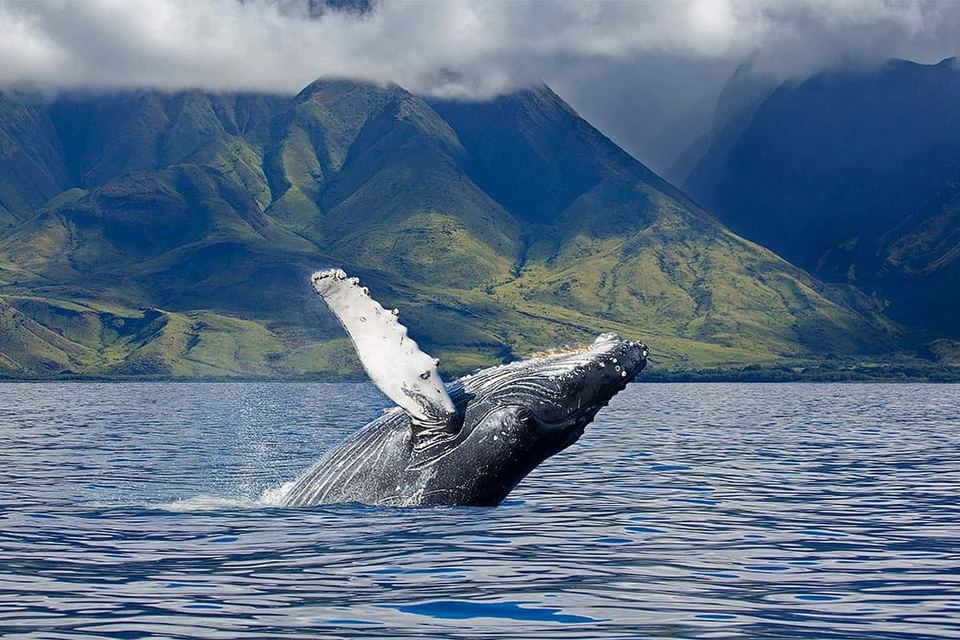
A breach in the Auʻau Channel, West Maui Mountains behind
Humpbacks are the most surface-active of the great whales, and off Maui in winter they are mating, calving and competing, so there is more to see here than on a feeding ground. Every trip is different and we will not pretend otherwise, but the same few behaviours repeat, and once you know them you can start to guess what a whale will do next.
The blow comes first. A humpback's exhale is a column of mist about fifteen feet high, and it is almost always how a whale is found, from a boat or from the beach. A whale takes a few breaths at the surface and then dives. If the tail lifts clear as it goes, that is a fluke-up dive and a longer wait; the pattern under each tail is unique, and researchers identify individuals from photographs of it. If the back arches and the tail stays down, the whale is likely to be up again nearby, soon.
Then the displays. A breach, when most or all of the whale leaves the water and crashes back, is the one everybody wants, and it is still not fully explained; breaches tend to come in runs, so keep watching the same spot. Tail slaps and pec slaps are probably signals to other whales. A spy hop, the whale rising vertically to look around above the surface, sometimes at the boat, is a very good day. Head lunges and peduncle throws are aggression, and usually mean a competition pod: several males charging, blocking and striking each other around one female. It is the most intense thing you can see in Hawaiian waters.
Mothers and calves. Calves are born here at ten to fifteen feet and put on something like a hundred pounds a day. A pair stays close to shore in calm water, the calf surfacing every few minutes, often with a third adult, an escort, alongside. Those are the whales you most often meet off Kaʻanapali.
And the song. Only males sing, and almost only here on the breeding grounds. A song runs ten to twenty minutes and may be repeated for hours, every male in the North Pacific population sings the same version, and the version changes from year to year. None of it reaches the surface. You need a hydrophone in the water to hear it, and in January, February and March there is often more than one singer at once.
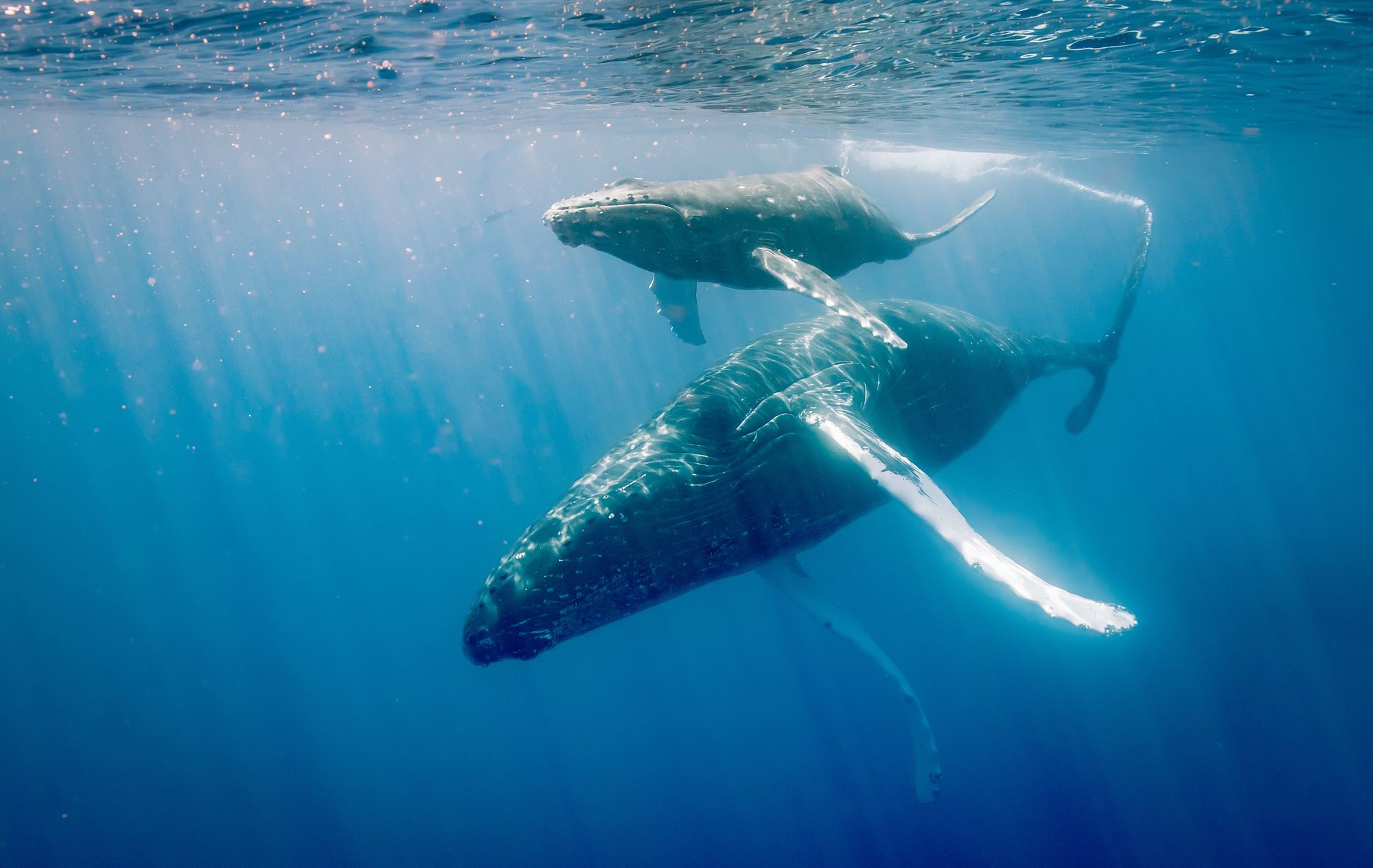
A mother and calf below the surface off Maui
Maui whale watches run on three kinds of boat, and they all see the same whales in the same channel on the same morning. What changes is the experience of being aboard: how close to the water you sit, how the ride feels, how many people share the rail, and what is on the boat with you. We run a raft, and it is not the right boat for everyone, so here is the honest comparison.
A raft is what people call a rigid hull inflatable boat, or RHIB: a solid hull with a thick inflatable collar, which makes it very stable side to side and lets it sit low. You are level with the whale rather than looking down on it, and a whale at a hundred yards looks far bigger from there than from a top deck. Rafts are fast, so they reach whales quickly and reposition when the whales move, and the ride is lively, smoothest in the morning. The trade-offs are real: open sides, so you may catch some spray; no restroom on ours; and a livelier ride than a big hull.
A catamaran has two hulls, which spread the motion, so it is steadier. You sit higher and look down onto the water. Large catamarans can carry well over a hundred guests, usually have a shaded area and often a restroom. A large cruise boat is usually the steadiest of all, the slowest to get anywhere, the highest off the water, and the most crowded. Individual boats vary, so ask the operator.
Whichever you choose, the federal 100-yard rule is the same for every boat. What we see on the water is that whales are more at ease around a small, quiet raft than around big boats, and they often come over to us on their own. When they do, we cut the engines and let them.
People who want to be close to the water. Photographers, for the low angle and the open sides. Families with young children: ages 2 and up, and 2 hours is about right for a young attention span. If you are very prone to seasickness, take the earliest trip or choose a bigger boat. If you need wheelchair access, a raft boarded by shuttle from a beach is not it. And we cannot take guests who are pregnant, at any stage, or who have back or neck problems, on any trip; a raft moving over chop jolts through the seat.
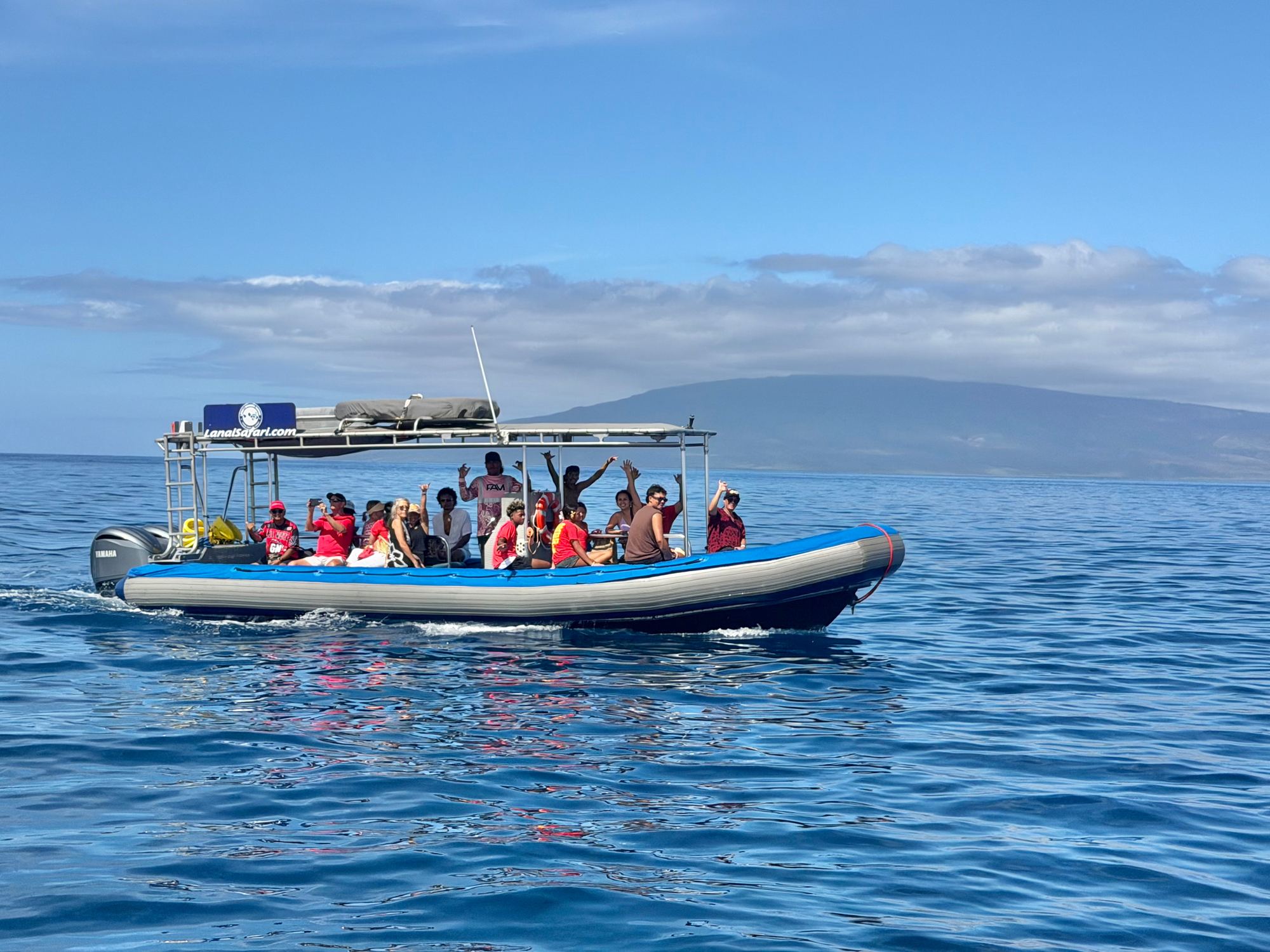
Our rigid hull inflatable under way off West Maui
TypeCustom rigid hull inflatable boat (RHIB)
PowerTwin outboard engines
ShadeFull coverage overhead
Capacity20 passengers max
BoardingShuttle boat from Kaʻanapali Beach, behind Whalers Village
AudioOnboard hydrophone, broadcast to the whole vessel
CrewCaptain plus MWA certified marine naturalist
A whale watch usually starts with a drive to a harbor or a ramp, a parking structure and a dock. Ours starts on the sand. The public tour and the private whale watch leave from Kaʻanapali Beach, behind Whalers Village, the beach most of our guests are already staying on. The meeting point is 2435 Kaʻanapali Pkwy, Lahaina, HI 96761; park in the Whalers Village structure, a short walk from the beach. It is not validated, so budget for it and allow a few extra minutes at peak times, particularly for the 7:00 AM trip.
Check-in is on the beach behind the mall. There is no terminal and no queue inside a building; our crew finds you on the sand and it takes a couple of minutes. Use the facilities at the mall on your way through, because there is no restroom on the boat.
Boarding is by shuttle boat straight off the beach behind Whalers Village, so there is no wading and no harbor commute. Then a safety briefing before anybody goes anywhere. Once we are under way the transit is minutes, because the whale ground starts a few hundred yards out: full shade overhead, the hydrophone in the water, and a naturalist talking you through whatever the morning gives you. Two hours later you are back on the same sand, off the earliest trip in time for breakfast with the whole day ahead of you.
The private sunset charter is the exception. It boards at Mala Boat Ramp, Lahaina — behind Safeway, a short walk from the parking area with no wading and no surf to climb through, and goes out in the late afternoon so the last of the light is on the water while the whales are still active.
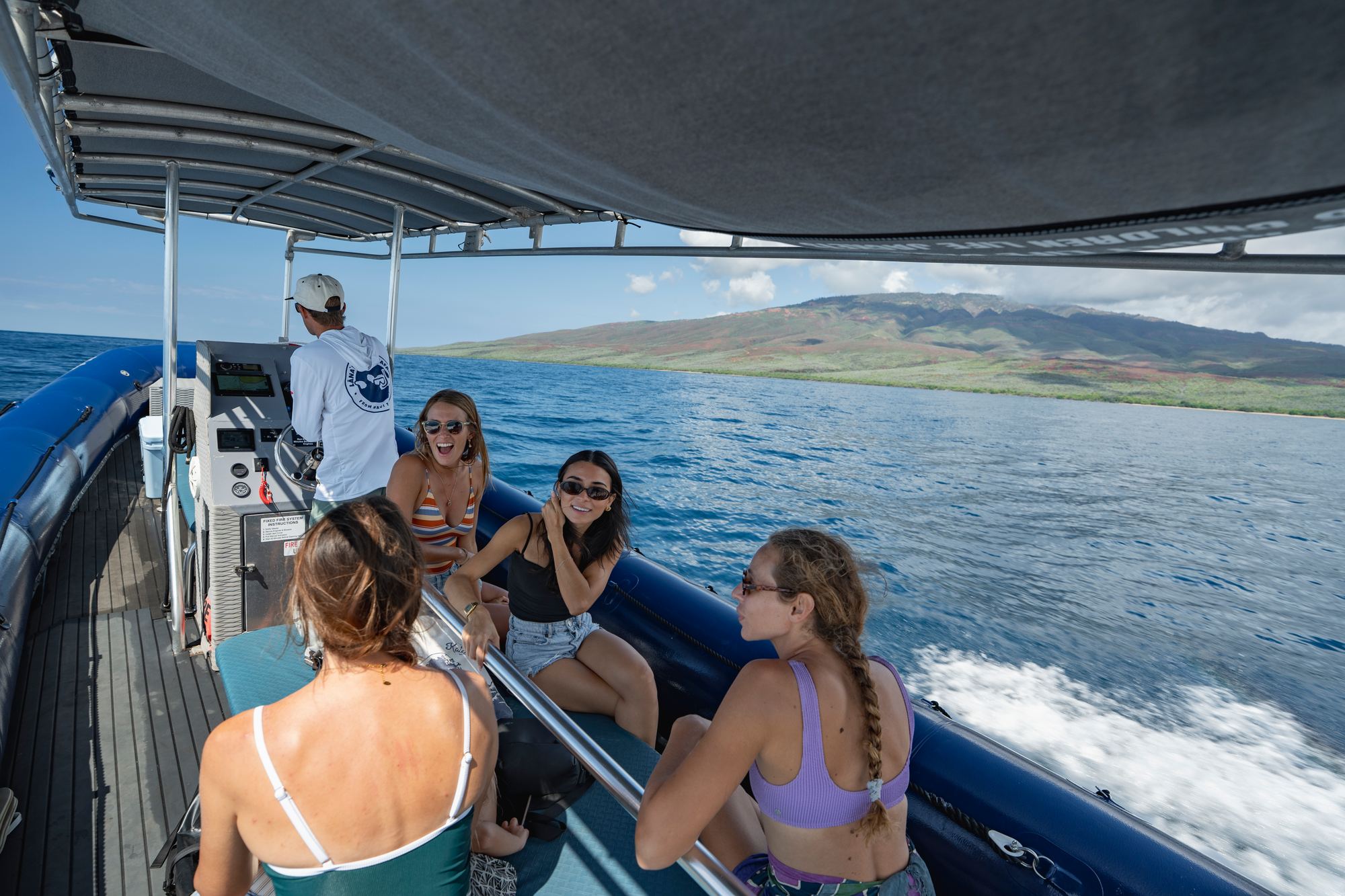
Aboard the raft, full shade overhead
Less than you think. A whale watch on Maui is a couple of hours on an open boat in sun and wind. The four things people ask us about most, each with its own guide.
Some people do get seasick; a raft is fast and stable but livelier than a large catamaran. Three things make most of the difference: take the earliest departure, when the channel is calmest; take anything for motion sickness before boarding rather than after; and keep your eyes on the horizon rather than on a phone. Sit in the middle or toward the back, facing forward, and tell the crew early if you start to feel it. We have a spot on the boat that usually helps. More, including general guidance on medicines, in the seasickness guide.
Our minimum age is two. The deciding factor is usually not age but whether a child will keep a life jacket on and stay seated while the boat is moving. Two hours is about the length of a child's attention on open water, the shuttle from the beach means nothing to climb through, and the hydrophone is the part they remember: children go very quiet when the song comes through the speaker. The honest answers for parents are in whale watching with kids.
Comfortable clothing, sunglasses, a light jacket or long-sleeve layer, a hat that stays on, water and a snack, and a waterproof case for your phone. On Maui the sunscreen has to be mineral: since October 2022 county law has allowed only non-nano zinc oxide or titanium dioxide sunscreens, and they are easy to buy on the island. We do not provide water or snacks; alcohol is not allowed. There is dry bag storage aboard, and the boat has full coverage overhead shade. The full list, and what to leave at the hotel, is in what to wear and bring.
The boat decides the picture. From a raft the lens is barely above the surface, there is no cabin or window between you and the animal, and at twenty guests there is room to cross the deck. Whales come up closer than you expect, so 70–200mm covers most of it; shutter priority at 1/1600 or faster handles the boat's motion, and burst mode catches the fluke, which comes up last. Phones do better here than people expect. Lenses, settings and the private-charter case are in whale photography.
We operate inside the Hawaiian Islands Humpback Whale National Marine Sanctuary, and the rules that protect the whales are also what make good whale watching possible. A calm whale behaves naturally, and a natural whale is the one worth watching.
The 100-yard rule. Federal regulations prohibit approaching a humpback whale closer than 100 yards in Hawaiian waters. We hold that line. Whales are free to approach us, and often do — which is why so many of our closest encounters happen with the engines off. It applies to every vessel in Hawaiian waters, whatever its size, and just as much to people in the water: swimmers, snorkelers, stand-up paddleboards, kayaks and drones all keep the same distance, and aircraft must stay 1,000 feet away. Swimming with the whales is not permitted, by us or by anyone else. This is a watching trip.
How we approach. We position and wait rather than pursue. Chasing changes a whale’s behavior, and a whale that is avoiding a boat is not one worth watching. We never place the vessel directly in a whale’s path or run up on it from astern. Approaches are made from the side, slowly and predictably. Mothers with newborn calves get more room than the minimum. Calves surface constantly and cannot maneuver away from a boat.
A recovery worth protecting. Commercial whaling reduced North Pacific humpbacks to a few thousand animals. The population that winters in Hawaiʻi has rebuilt to the point where it was removed from the Endangered Species List in 2016, and it remains federally protected under the Marine Mammal Protection Act. The threats now are quieter ones: vessel strikes, entanglement, and underwater noise. Every one of those is affected by how boats behave around whales.
If you see a whale that looks entangled, injured or stranded, from a boat or from shore, call NOAA's marine mammal hotline on 1-888-256-9840. We log unusual sightings and report to the same number.
Three trips, all 2 hours, all on the same low, twin-engine raft with a hydrophone and a certified naturalist aboard, all ages 2 and up. What differs is who else is on the boat and where you leave from. Each figure is a starting price; the booking calendar shows the live rate for the date you pick.
From $1,350 per boat · Private charter, up to 20 guests
From $1,250 per boat · Private charter, up to 20 guests
Humpback whale season runs from December through April, with peak sightings typically in January, February, and March.
February and March are the peak. The season builds through December and January as the whales arrive from Alaska, holds at its highest density through February and March — that is when calves are being born and singers are everywhere on the hydrophone — then tapers in April as males and juveniles head north first. Mothers with new calves linger latest.
Ours start at $79 per guest for the two-hour public raft tour off Kaʻanapali Beach. The private whale watch from the same beach starts at $1,350 per boat and the private sunset charter out of Mala Boat Ramp at $1,250 per boat — both take the whole boat for your group alone, up to 20 guests. The arithmetic worth knowing before you ask us: a private charter only costs the same per head as a public seat at around 17 guests, so below that you are paying for the boat to yourselves rather than for a cheaper seat. All three are starting rates that move with the date and the season, and the booking calendar shows what a specific departure costs before you commit to it.
All tours depart from Kaʻanapali Beach, behind Whalers Village. Private sunset charters depart from Mala Boat Ramp in Lahaina.
No closer than 100 yards. Federal regulations prohibit approaching a humpback closer than that in Hawaiian waters and we hold the line. Whales are free to close the distance themselves, and often do — which is why so many of our best encounters happen with the engines off.
Yes — you will see whales. During whale season our sightings are 100%, and our captains know exactly where to find the action. If you don’t see a whale on your trip, we will gladly bring you back again free of charge.
Every guide on the site, one line each. This page is the summary; these are the detail.
The migration month by month: why they come, when they arrive, when they leave.
This season's dates, and the second raft being built in Lahaina.
Every coast, named as landmarks, with when to look and what you will see.
Breaches, slaps, spy hops, competition pods, and what each one means.
The five things that actually differ between Maui boats.
Eye level, ride and speed, and who should pick a steadier boat.
Where the boats leave from since Lahaina Harbor closed.
Why morning water is calmer, where to sit, when to take medicine.
Ages two and up, two hours, and the honest answers for parents.
Layers, mineral sunscreen, a phone case, and what to leave behind.
Lenses, shutter speeds and why a low, open raft makes the picture.
The federal rules we run by in the sanctuary.
2 hours off Kaʻanapali Beach, behind Whalers Village, up to 20 guests, from $79 per guest. Season runs December – April; peak weeks in January, February and March book out first.
Check Dates & Book